COLORADO
Larger Vehicles, Including Recreational and Commercial Motor Vehicles
As of August 7, 2024, all commercial motor vehicle drivers must carry chains from September 1 to May 31. This applies to vehicles with a combined weight of more than 16,000 lbs used in commerce or as transport for at least 16 passengers (including the driver) on public highways. View the Colorado chain up tips(opens in new window)(consejos para colocar cadenas en Colorado)(opens in new window) handout for more information on what must be carried by CMVs.
Commercial vehicles and buses have a larger footprint on roadways where chains are required. CMVs must carry chains or ATDs on all the following roads regardless of current weather:
- I-70 west of milepost 259 (Morrison) to the Utah border.
- Colorado Highway 9 mile post 63 to milepost 97 (Frisco to Fairplay).
- Route 40 milepost 256 (Empire) to the Utah border.
- U.S. Route 50 milepost 225 (Salida) to the Utah border.
- U.S. Route 160 milepost 304 (Walsenburg) to the New Mexico border.
- U.S. Route 285 milepost 250 (Morrison) to the New Mexico border.
- All of U.S Route 550.
Those required to chain 4 drive tires:
- Straight Trucks: 4 tire chains, 4 AutoSocks, 4 tire cables 0.415 diameters or greater, auto chains, or sanders.
- Single Drive Axle Combinations: 4 tire chains, 4 AutoSocks, auto chains, or sanders. No cables are allowed.
- Tandem Drive Axle Combinations: 4 tire chains, 4 AutoSocks, 4 tire cables 0.415 diameter or greater, auto chains, or sanders. If chains are on the 2 outside tires of one drive axle, any tire cable may be used to cover 2 tires on the other drive axle. AutoSocks may be used to cover 2 tires on the other drive axle. AutoSocks and tire cables cannot be used together.
- Auto Transporters: 4 tire chains, 4 AutoSocks, 4 tire cables 0.415 or greater, auto chains, or sanders. Do not use chains if use places hydraulic lines at risk of damage (alternative traction devices (ATDs) may be used to mitigate the risk). Travel will be restricted if the vehicle is unable to chain.
Those Required to chain 2 drive tires:
- Buses: 2 tire chains, 2 tire cables 0.415 diameters or greater, 2 AutoSocks, auto chains, or sanders.
- Hot shot trucking: Traditional motor vehicles (such as pickup trucks) that are pulling trailers and meet the above-listed weight criteria must also carry chains. 2 tire chains for singles (to affix to rear tires). Exception: Duallies need 4 tire chains.
Idaho
The law only applies to commercial vehicles over 26,000 pounds on mountain passes, most notably on I-90 east of Coeur d’Alene and on US-12 at the Montana border.
MONTANA
When the Department of Transportation determines tire chains or traction equipment are required, all vehicles towing a trailer (towing units) must apply chains to the driver wheels of one axle.AutoSock’s are an approved alternative to tire chains. Designated chain-up and removal area signs are posted in areas where tire chains may be required. Ref: MCA 61-9-406
Studded winter tires are permitted in Montana from October 1 to May 31 of the following year, except that one of those tires may be used for a spare in case of tire failure. School buses equipped with such tires are permitted from August 15 to June 15 of the following year. Ref: MCA 61-9-406
Between October 1 and April 30 of the following year, towing units 26,001 GVW or greater must carry tire chains or an approved traction device when traveling in an area where tire chains may be required. Note: This does not apply to a vehicle with four-wheel drive. Ref: MCA 61-9-436
A complete guide for which highways chains are required: Chain Guide
WASHINGTON
Chain Requirements for Vehicles Over 10,000 Pounds
Tire Chain Requirements for Vehicles Over 10,000 Pounds (GVW).
This Diagram of proper chain placement (PDF 20KB) shows where chains are required for different axle configuration. All vehicles weighing over 10,000 pounds must carry at least two extra tire chains. Extra chains are needed in case road conditions worsen, or the chains break or become unusable – regardless if chain up requirements are posted or not.
Chains must be two-sided, not plastic, and with sufficient hardened metal. At least one cross-chain must be in contact with the road surface at all times. The Washington State Patrol may approve other devices as chains, but the devices must be equivalent to regular chains in performance (cable chains allowable).
Dates
- From November 1 to April 1: Chains must be carried at all times, regardless of road conditions or advisories.
- From April 2 to October 31: Chains must be carried only when specifically posted for different axle configurations
Routes
- I-90 between North Bend (MP 32) and Ellensburg (MP 101)
- I-82 between Ellensburg Exit 3 (MP 3.00) and Selah Exit 26 (MP 26.00)
- SR-97 between (MP 145) and Junction
- SR-2 between Dryden (MP 108) and Index (MP 36)
- SR-12 between Packwood (MP 135) and Naches (MP 187)
- SR-97 between junction SR-14 (MP 4) Columbia River and Toppenish (MP 59)
- SR-410 from Enumclaw to Naches
- SR-20 between Tonasket (MP 262) and Kettle Falls (MP 342)
- SR-155 between Omak (MP 79) and Nespelem (MP 45)
- SR-970 between (MP 0) and (MP 10)
- SR-14 (MP 18) to Junction 97 (MP 102)
- SR-542 Mt Baker Highway between (MP 22.91) and (MP 57.26)
You don’t need chains for local deliveries if you stay outside the chain-required areas and don’t cross a mountain pass. WSDOT or WSP may stop vehicles without chains from going into areas where chains are required.
Oversize load movements
Movement by permit on mountain passes is prohibited where any of the following signs are displayed:
- Traction Advisory/Oversized Vehicles Prohibited
- Vehicles over 10,000 GVWR, Chains Required
- Chains required on all vehicles except all-wheel drive
Wyoming
Wyoming’s Chain Law
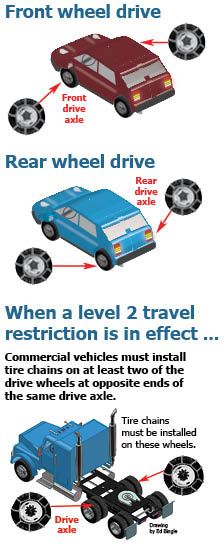
Wyoming’s chain law includes two levels of restrictions that can be implemented on specific highway sections when conditions warrant. Wyoming’s chain law includes two levels of restrictions that can be implemented on specific highway sections when conditions warrant.
Level 1
When conditions are hazardous, travel can be restricted to:
-
- Vehicles equipped with tire chains; or
- Vehicles with adequate snow tires; or
- All-wheel-drive vehicles
Level 2
When conditions are extremely hazardous, travel can be restricted to:
- Vehicles equipped with tire chains; or
- All-wheel-drive vehicles equipped with adequate mud and snow or all-weather-rated tires.
Under Level 2, commercial vehicles must have chains on at least two of the drive wheels at opposite ends of the same drive axle.
Do not stop in the driving lane to install or remove chains!
Penalties for violations:
- $250 for violating the travel restriction; or
- $750 for a violation that results in a highway closure.